Dr. Zhao unpacks AI’s impact on children
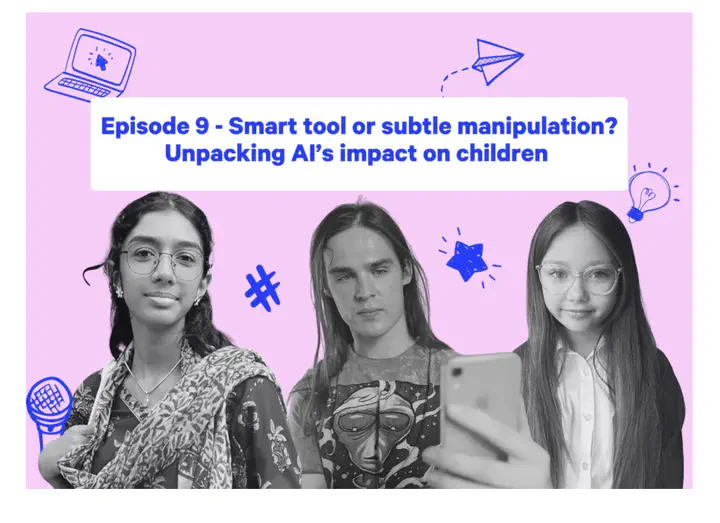
Tech This Out! Episode 9 Recap — “Smart Tool or Subtle Manipulation?”: How AI Is Shaping Children’s Lives
In Episode 9 of Tech This Out!, titled “Smart Tool or Subtle Manipulation?”, 5Rights Youth Ambassador Aisling and Dr. Jun Zhao, senior researcher at Oxford University and co-founder of the Child-Centred AI Design Lab, unpack how AI is impacting children and teens — for better and for worse.
📱 How AI Is Already in Kids’ Lives
From making art to doing homework, kids are experimenting with AI in all sorts of creative — and sometimes questionable — ways. AI can feel like a friend, a tutor, or even a personal assistant. But Dr. Zhao reminds us: while AI is incredibly powerful, it doesn’t come with warning labels. And that’s where the risks begin.
Most of us don’t realise how deeply AI is embedded in children’s routines:
- Smart alarms that learn sleep patterns
- Personalised playlists and video recommendations
- Navigation apps that predict traffic
- Chatbots that help (or do) schoolwork
AI is often invisible but influential — shaping children’s choices, preferences, and even their thinking habits.
⚠️ I poses severe risks, including over-reliance, manipulation, and mental health
Dr. Zhao warns of the over-reliance on AI tools, especially in learning. When kids let AI do the thinking for them, they risk losing problem-solving skills and critical thinking. And the impact isn’t limited to academics.
AI-driven systems often rely on persuasive algorithms, which are:
- Designed to keep kids engaged
- Tailored to emotional triggers like stress or boredom
- Built to profit from attention, not necessarily support well-being
This subtle manipulation can affect children’s mental health, behavior, and even their sense of identity.
🕵️♀️ Transparency & Data Concerns
Unlike older technologies (like TV), AI systems collect, analyze, and respond to children’s data — often without clear consent or understanding. Whether it’s chatbots building digital “friendships” or autoplay feeds encouraging endless screen time, these tools can exploit emotional vulnerabilities.
“Children may think they are making independent choices,” says Dr. Zhao, “but in reality, they are responding to sophisticated manipulations.”
✨ The Good News: AI Can Empower
Despite the dangers, there are inspiring examples of positive, thoughtful AI use:
- Students using AI as a brainstorming partner to overcome creative blocks
- Kids designing AI tools to learn sign language or help rural farming
- Personalised AI tools helping toddlers develop impulse control or motor skills With the right design and intention, AI can enhance creativity, support development, and encourage human connection.
📚 The Future of Learning
AI is changing how kids learn:
- 80% of teens aged 13–17 are now using generative AI
- 60% use it for homework or studying
- Tools are emerging that adjust in real time to each student’s ability level
Still, kids trust family over AI when it comes to information — a hopeful sign that human relationships remain central.
🧠 Should There Be Rules?
Absolutely. Dr. Zhao and organizations like 5Rights Foundation are leading the charge for better governance and ethics in child-facing AI. New frameworks like the Children’s AI Design Code aim to:
- Include children’s voices in development
- Require transparency from tech companies
- Address risks like bias, manipulation, and environmental impact Young people are already advocating for these changes — and they must be included in decision-making.
Aisling, the young host of the episode, closes the episode with a powerful reminder:
“AI is like Pandora’s box — it’s out there now, and we need to make sure it brings more good than harm.”
🎧 Listen to the full episode here: Tech This Out! - Episode 09 📢 Get involved. Speak up. Shape the future.
This episode is part of 5Rights’ Tech This Out podcast series on AI, which also feature speakers like Prof. Shoshana Zuboff’s discussions on surveillance capitalism in part 1 and part 2.
OxfordCCAI
Organisation
Oxford Child-Centred AI (Oxford CCAI) Design Lab assembles a series of research activities related to designing better AI for and with children. It is part of Human-Centred Computing at the Department of Computer Science at the University of Oxford.