OxfordCCAI researchers awarded a new IAA grant
We are very excited to share that OxfordCCAI researchers have been awarded a new IAA grant to work on early-years parent–child relational mediation.
Titled “Establishing a Research-to-Practice Ecosystem for Generative AI in the Early Years: A Case Study Designing AI to Support Agency and Parent-Child Connection,” the project is led by Dr Isobel Voysey, in collaboration with BabyZone and Oxford Edge, and supported by Professor Reuben Binns and Dr Jun Zhao.
The project is set against a backdrop in which the vast majority of children under five are already using digital systems, while AI-enabled products are spreading rapidly. However, many AI systems do not align with the developmental characteristics of early childhood, and there is a lack of evidence on the impacts of AI on young children.
This project aims to explore how generative AI can be used in the early years in ways that support children’s agency and strengthen parent–child connection, rather than replacing interaction with a “digital pacifier”. It builds on our research showing that current AI design pays too little attention to agency and family context, and extends and applies these research insights to the early years.
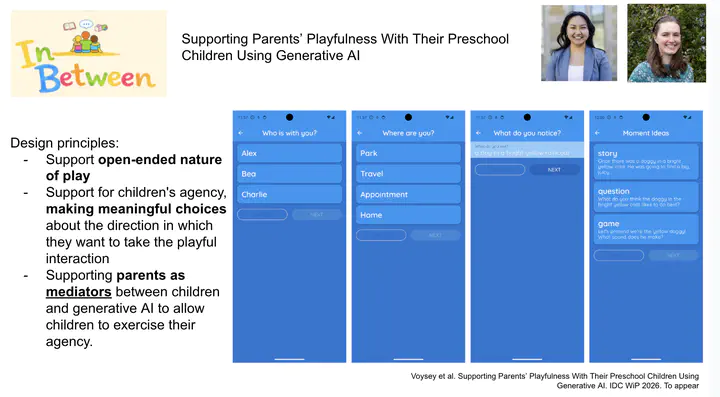
Working with Babyzone](https://babyzone.org.uk/), an early-years charity whose Hubs act as living labs, researchers will co-design, test, and refine an existing mobile app that uses generative AI to suggest playful story starters, conversation prompts, and games during everyday “in-between” moments, such as waiting for a bus or doing chores. The team will develop the prototype into a minimum viable product and evaluate it through workshops, a lab study, and a four-week home study with families.
Beyond the app itself, the project aims to build a wider ecosystem for responsible AI in the early years. It will bring together researchers, early-years organisations, funders, policymakers, and innovators to share findings, set priorities, and create a stronger pathway from research into practice. The expected benefits include a better understanding of what families and practitioners need, a more developmentally appropriate AI prototype, stronger evidence that generative AI can support parent–child interaction, and longer-term influence on policy, practice, and future products for young children.

OxfordCCAI
Organisation
Oxford Child-Centred AI (Oxford CCAI) Design Lab assembles a series of research activities related to designing better AI for and with children. It is part of Human-Centred Computing at the Department of Computer Science at the University of Oxford.