Agency in Child–AI Interaction: A Review of How It Is Conceptualised, Studied, and Supported in HCI
 Agency lit review
Abstract
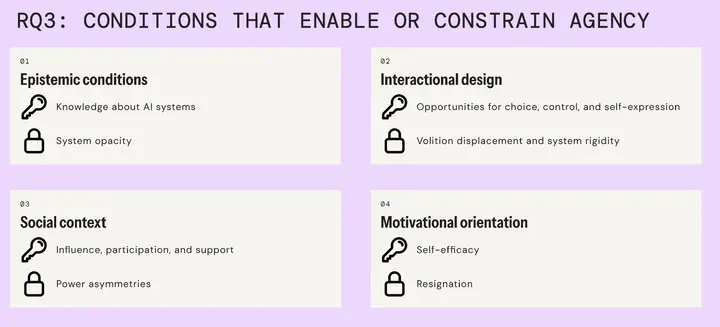
Children’s lives are increasingly intertwined with AI systems, from recommender algorithms to generative models, raising concerns about potential impacts on children’s agency. Although supporting human agency, autonomy, and empowerment is a widely shared HCI goal, we lack clear definitions of these concepts in designing child-AI interaction. Through a review of 25 recent HCI studies, we find agency is rarely explicitly defined and its conceptualisation varies across something children innately possess and something to be developed. Our literature mapping shows that researchers observed agency through children’s planning and self-regulation, asserting control over AI systems, and critique and re-design of the status quo. Conditions reported by researchers that enable or constrain agency span epistemic conditions, interactional design, social context, and motivational orientation. Our review highlights gaps in research on designing for children’s agency. We advocate for conceptual clarity by drawing upon existing frameworks and highlight the importance of considering children’s agency through a relational lens.